– New Year’s Day 2025 concert opens Bedford Park’s 150th anniversary celebrations
– A Viennese New Year at St Michael’s also celebrates the Strauss bicentenary
The 150th anniversary of Bedford Park got off to a flying start with a packed-out concert, ‘A Viennese New Year at St Michael’s’, on New Year’s Day. See report at The Chiswick Calendar.
In a joyous concert that also marked the bicentenary of the Waltz King, Johann Strauss II, David Juritz and the Strauss Orchestra of London brought Vienna to St Michael & All Angels Church, London W4.
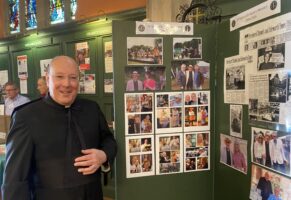
Presented by broadcaster, musician and lecturer Sandy Burnett, a specially chosen programme included star turns by soprano Milly Forrest, virtuoso pianist Mark Viner and Father Kevin Morris, the vicar of St Michael & All Angels Church.
As well as essential Viennese classics such as the Blue Danube, Radetsky March and Thunder and Lightning Polka, the music reflected life, past and present, in the world’s first garden suburb. It included Bahn Frei by Eduard Strauss, a reference to the steam train that ran from London to Turnham Green, made famous by Camille Pissaro’s painting. The station master was Fr Kevin, with a suitable hat, bell and whistles.
See full programme and performers. 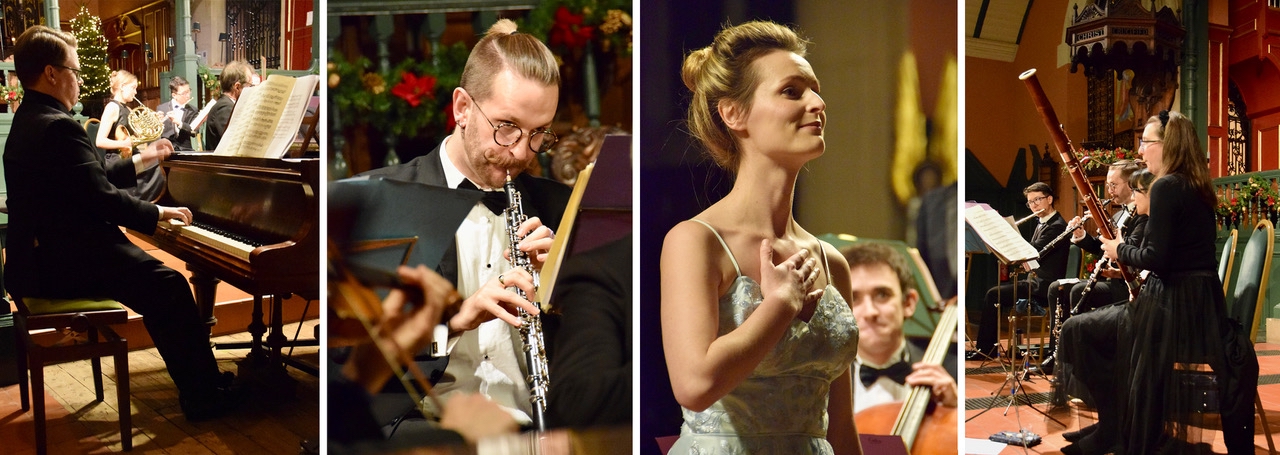
The inaugural concert on New Year’s Day 2024 was a sell-out. See photographs above and at: A Viennese New Year at St Michael’s 2024.
Profits from the concert will be shared between two charities: The Upper Room and St Michael & All Angels Church’s Heritage Conservation Fund. The concert is generously sponsored by Home Instead, Hammersmith & Chiswick.
The concert was the first of a series of anniversary events in 2025 being co-ordinated by The Bedford Park Society and St Michael & All Angels Church. Celebrating the rich architectural heritage and social history of Bedford Park, the events will be open to everyone and will be widely promoted under the specially designed 150th logo (above).
More concert information from Torin Douglas at torindouglas@gmailcom.
More information about Bedford Park from The Bedford Park Society at information@bedfordpark.org.uk.
NOTES TO EDITORS
* Bedford Park was founded in 1875 as the first garden suburb and its origins were inspired by the Aesthetic Movement of the 1870s. It immediately attracted a community of artists, architects and other aesthetic types and was immortalised in G.K. Chesterton’s story, The Man Who Was Thursday. An advertisement of the time proclaimed it to be “the healthiest place in the world (Annual Death Rate under 6 per thousand)”.
* Bedford Park houses, in the Queen Anne style of architecture, are based on designs by Victoria architects Norman Shaw, E. W. Godwin, E.J. May and Maurice B. Adams. Pretty tree-lined avenues of family homes with gardens were interspersed with artists’ studios. Community buildings, including the Church and Parish Hall, the Stores, a School of Art, the Tabard Inn and the Club, helped to create an integrated ‘village-like’ community, living in ‘sweetness and light’. See Bedford Park Society’s Galleries.
* Among Bedford Park’s ‘progressive’ early residents were the poet W.B. Yeats, dramatist Sir Arthur Pinero, architects C.A. Voysey, Maurice Adams and E.J. May, actors William Terriss and Florence Farr and artists T.M. Rooke and Lucien Pissarro, whose father Camille painted several views from the house.
* It was described by the Poet Laureate and heritage campaigner John Betjeman as “the most significant suburb built in the last century, probably the most significant in the western world.” Bedford Park’s buildings and community spirit became an inspiration and model for the creators of later garden suburbs and cities in Britain and around the world.
* During the 1960s some of the houses were demolished and others increasingly came under threat. In 1967, after a campaign supported by John Betjeman, The Bedford Park Society and St Michael & All Angels Church, Bedford Park became a conservation area. More than 350 houses are listed as Grade II and the church and inn are Grade II*.