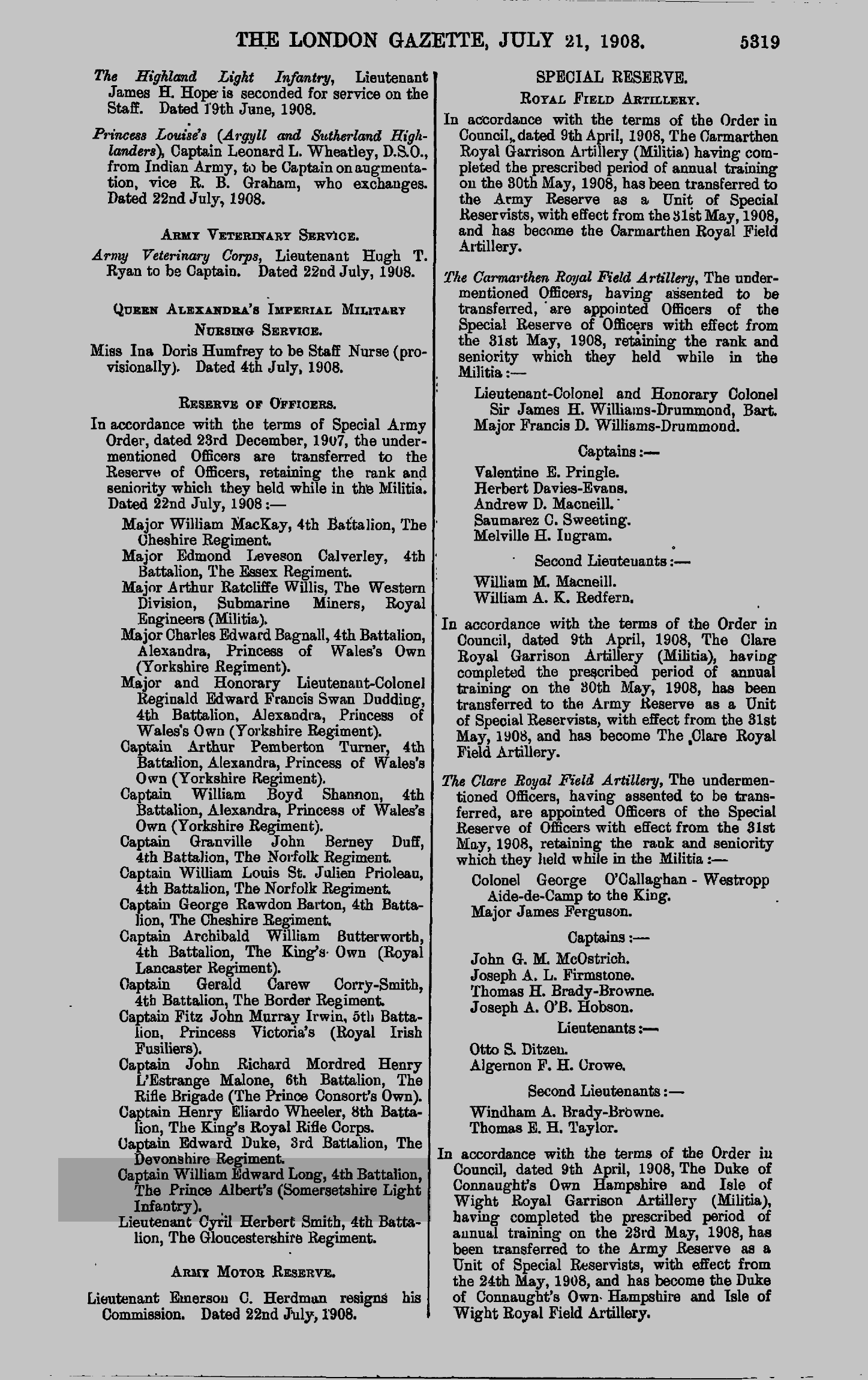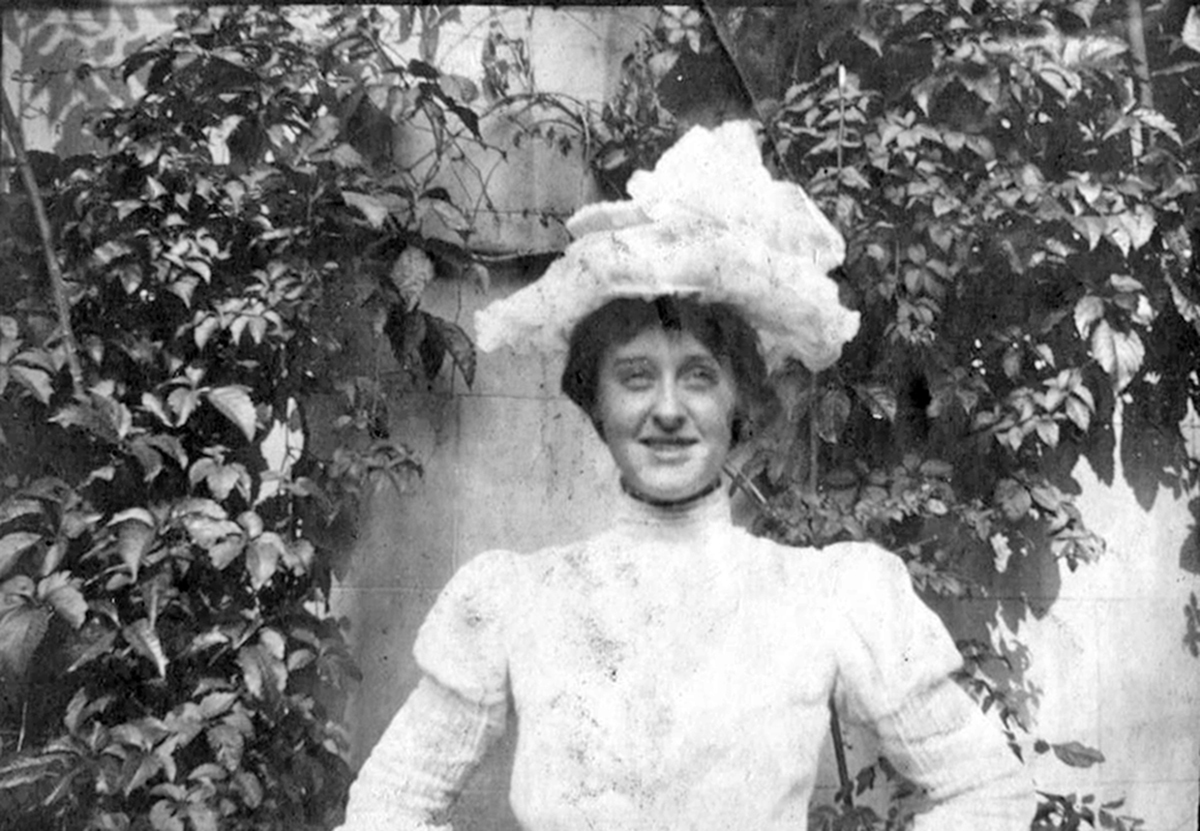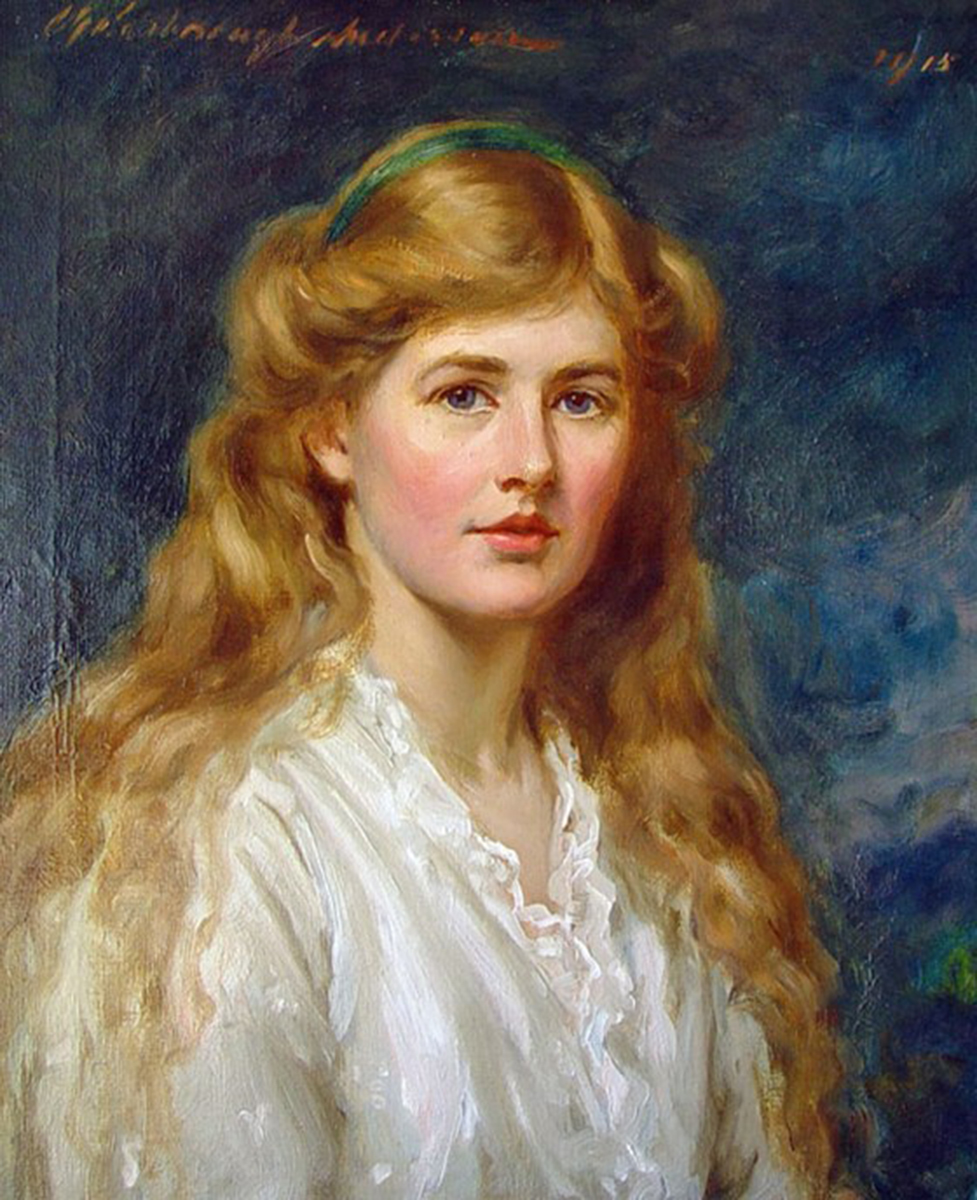
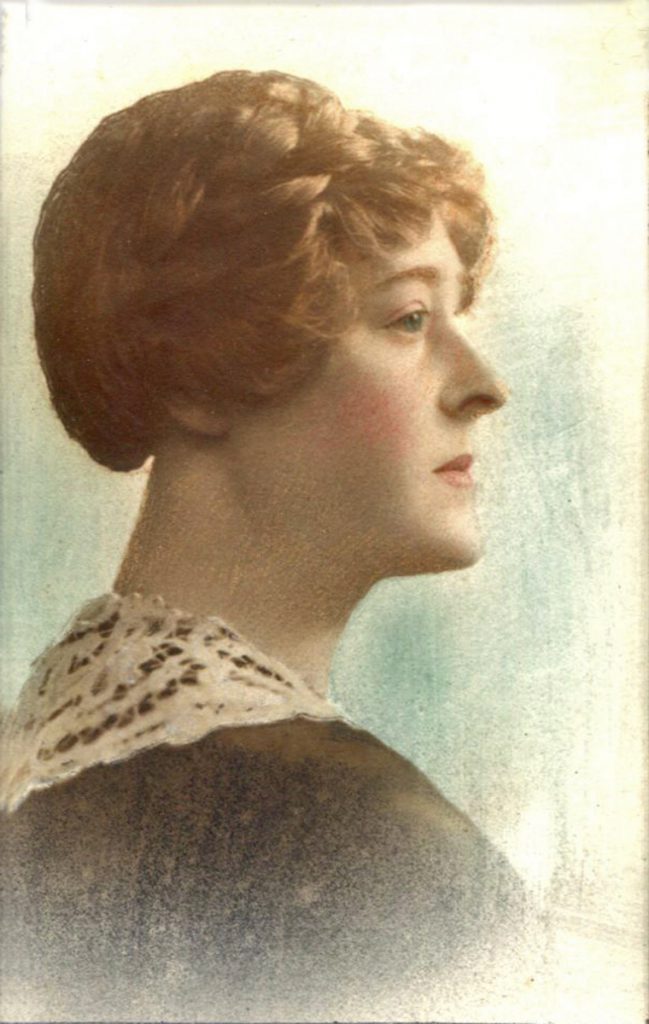
Violet Beatrix Alice Lambton Way was born on 30 April 1883, in Newcastle on Tyne, the fourth of five children of Colonel Wilfred FitzAlan Way and Henrietta Mary Ross. He had served in the 4th Battalion, Somerset Light Infantry, latterly in India before retiring from service in the 1890s. In the census record of 1901, Violet was living with her parents in Portsmouth, together with her elder married sister, Florence Edith Victoria Leach, whose husband, Henry Burleigh Leach was serving in the South Africa War with the Northumberland Fusiliers as a Captain. (He subsequently served in command of 1st.South Wales Borderers at Ypres as a Lieutenant. Colonel). A second daughter, Ethel Edith Hamilton Way had married Capt. Frederick Guggisberg in India. Daisy Maud Annie Kathleen Way, the youngest daughter had been born in India in 1890. Violet’s elder brother,Wilfred Greville Martin Way had been born in Chatham in 1976, and was serving as a Lieutenant in the Royal Navy in 1901. He served as a Captain in the Royal Horse Artillery during the War.
We are fortunate to have had access to Violet’s photograph albums spanning much of her life, by courtesy of Martin Boyle, one of her grandchildren. As a young girl towards the end of Queen Victoria’s reign she seemed to have had a fairly carefree time, mainly based on the family home in Portsmouth, attending social events, military sports meetings, bicycling and other activities.
Violet was only just 18 when she married Captain William Edward Long (born 1873) at St George’s Church, Hanover Square, between July and September 1901.
William (“Bill”) Long was the son of Colonel William Long (1843–1926), CMG, Somerset’s Deputy Lieutenant and JP, of Newton House, Clevedon Somerset and Woodlands, Congresbury, Bristol – a prominent Somerset figure. His son was educated at Eton College and Oriel College, Oxford. In his turn, William Edward then held commissions with 4th Hussars and the Somerset Light Infantry, was wounded in the Boer War, and also saw service in Penang, Malay States, and elsewhere, accompanied by his young wife until he was transferred to the Reserve of Officers in about 1908. During their return from the Malay States, the couple spent time in Aden and Cyprus and visited Gibraltar and Spain, where her sister Florence accompanied them – when her uncle had been posted there as Governor. Many of the photographs from this time capture much of the atmosphere of the Edwardian period. Recalled early for service in the War in 1914, “Bill” served in the Remount Service, rising to the rank of Major.
The couple was therefore steeped in military service. Violet had two daughters, Felicite Annette Cynthia, born in 1905, and Violet Maud Edith in May 1911. A third child died in infancy. It seems it was in about 1910-11 that the family moved to London, initially in Battersea at Overstrand Mansions. While there, Violet had witnessed the funeral procession of King Edward VII, and also the Coronation procession of King George V. The family will have moved to Bedford Park in about 1913, briefly in Bath Road, and then at 4 Abinger Road.
After war was declared in 1914 Violet determined to follow her sister Florence in serving the war effort. Initially, she trained in first aid and maternity nursing in a voluntary civilian capacity, forming a local Voluntary Aid Detachment (VAD) and serving the local poor in Chiswick. She undertook classes in the St Michael’s parish rooms. When the Marchioness of Londonderry’s Women’s Legion was launched in 1915, Florence her sister volunteered and soon rose to a senior administrative position. The Women’s Legion was involved in many forms of work, including cooking and catering for the army at home. It was influential in encouraging the Government to organise female labour in the last half of the war. In 1917, the various women’s voluntary bodies, Women’s Legion, St.John Ambulance Brigade, VAD and First Aid Nursing Yeomanry (FANY) were reorganised into a paid government service, the Women’s Army Auxiliary Corps, and the first WAACs went to France on 31 March 1917. Mrs. Florence Burleigh Leach became its second Chief Controller and appointed her sister Violet as her deputy, latterly Chief Controller for Administration. Both sisters were appointed to the Order of the British Empire in 1918. Additional information about QMWAAC and role of the Way sisters can be found here.
Chief Controller Violet Beatrice Alice Lambton Long nee Way OBE died at sea in the English Channel on 3 August 1918. The Ambulance Transport Ship HMAT Warilda in which she was travelling, on return from an inspection of WAAC units serving American troops in France, was hit by a torpedo from a German U-boat and sank. The detailed circumstances of Violet’s death, only 3 months before the end of the war, is described below. Both Felicite Annette Cynthia and Violet Maud, cared for after their mother’s death by their aunt Florence, subsequently married and had families that thrive to this day. Their father died in Malaga only in 1961.
Other than on St Michael and Angels Parish memorial, Violet its commemorated at St. Andrew’s church, Clevedon, Somerset , on the Hollybrook Memorial in Southampton and on the “Women of the Empire Memorial, York Minster, created in 1923 when the Five Sisters window was reconstructed after the Great War and to which it was re-dedicated. An obituary in the Chiswick Times quotes the Vicar of St Michael’s: “… she was a splendid specimen of womanhood whose loss will be deeply mourned by all who knew her. She helped in the training of a large number of candidates in the Parish Hall for the examination by the St. John Ambulance Society, who are now doing good work for the Empire at this crisis She was able and pleasant in her manner, with a good capacity for organisation … Among the many from Chiswick who have done honourable service and sacrificed their lives heroically for their country the name of this gracious lady will be remembered with sorrow and yet with pride.”
She was aged 35 at her death.
We particularly offer our gratitude to Martin Boyle for his generous help with this biographical account.
THE SINKING OF HMAT WARILDA
HMAT Warilda (His Majesty’s Australian Transport) was a 7713-ton vessel, built by William Beardmore and Company in Glasgow as the SS Warilda for the Adelaide Steamship Company. She was designed for the East-West Australian coastal service, but following the start of the First World War, she was converted into a troopship and later, in 1916, re-converted into a hospital ship. She spent a few months stationed in the Mediterranean before being put to work transporting patients across the English Channel. Between late 1916 and August 1918 she made over 180 trips from Le Havre to Southampton, carrying approximately 80,000 patients in all.
On 3 August 1918, she was transporting over 600 wounded soldiers from Le Havre to Southampton, together with crew and medical personnel, a total of 801 persons. It was a trip that they had been well-used to, having made it some 180 times already. Her white superstructure and large red crosses were intended to give her the protection of the International Committee of the Red Cross but as with a number of other hospital ships, such as the Centaur torpedoed during the war, Germany claimed the ships were also carrying arms.
Chief Controller Violet Long had taken over a contingent of staff to France to work with the American Expeditionary Forces and to gather information for a report to her sister on how the QMAAC’s service with the Allied forces was progressing. With her work completed, she managed to get a berth back to England on board Warilda with her orderlies. The night was very dark, but the sea was smooth and visibility was about half a mile, so there could have been little difficulty in recognising that she was a hospital ship. At 01.35 a.m. Hans Kükenthal in command of the German U-boat UC-49 fired a single torpedo at the hospital ship. He had given no warning. The torpedo hit the ship aft on the starboard quarter, disabling the Warilda’s starboard propeller; but the port engine could not be shut down because the engine room had been flooded, and the steering gear blown away, so the ship continued moving in a circle at about 15 knots, almost full speed. The escort ships tried to take it in tow, but failed. It was a situation that spelt catastrophe for launching lifeboats. Characteristically, Violet was the last woman to leave the ship, having made sure the two QMAAC in her care were safely off. As Violet boarded the lifeboat it lurched and capsized and she fell into the sea. Violet was badly injured and trapped by ropes from the ship under the water line. Despite the best efforts of those who came to her aid, she could not be saved and her body could not be recovered. The ship sank after about two hours. Over 100 of the wounded, including many those in the “Eye Ward” trapped in one of the lower decks due to the collapse of the main companionways. A number of Hospital ships had been thus destroyed during the war, a fact much used for allied propaganda (see poster below).
Two eye-witness reports vividly describe the events:
1. Sister Daisy Ellen Dobbs, Territorial Force Nursing Service:
“When we arrived on board we found out that two V.A.Ds were making their way home from France, and Mrs Long, Commander of the W.A.A.Cs and her orderly. We consisted of two sisters of the T.F.N.S. and myself, making a number of seven altogether. After dinner we went to see the wounded officers and men to help them talk, oh… What an interesting time we had, the thrilling adventures which made us glow with admiration and filled us with a longing to do more for these men who willingly gave their lives for us. How time flies, we helped fix life belts until the signal for “lights out” made us seek our cabin…
“We were awakened by two terrible crashes and we felt the ship vibrating violently, the sound of running feet, and someone opened our cabin door and said, “To your boat at once sisters, we have been torpedoed” …
“… we made our way to our boat which had been pointed out to us the previous evening. It was so dark that we could not see, only felt some hands passing us along, while the wounded men who could help them-selves lined ready to get into their boats, the stretcher cases were in the hands of the Medical Officers and the orderlies under their supervision did splendid work …
“We were warned that a number of depth charges were to be sounded, the shock was severe, but we consoled ourselves thinking that we had sunk the Hun. We stopped again to take on board some more survivors, and to our delight we found our friends and listened to their terrible experiences. We were sorry to hear that our friend Mrs Long had been drowned trying to jump from the “Warilda” into the small boat and falling between, became entangled in the ropes, every effort was made to release her but when the ropes she must have collapsed and was drawn under by the suction.”
2. Ms. Charlotte Trowell, QMAAC
“I was acting as orderly to Mrs Long. There was no warning of impending disaster when I retired to my bunk at a quarter to twelve. Mrs Long came to my bunk just before retiring herself and enquired ‘Are you comfy?’ and gave me some chocolates.
“When the torpedo struck the vessel I was thrown out of my bunk. I hurried on deck, and just as I got up there the stairway was blown up. There was no panic. Those wounded boys, although dying, were splendid. I was put into a boat filled with wounded, but as the vessel sank our boat was not level. A davit rope was cut, but the boat capsized and we were thrown into the water. I clung to a rope and a wounded American Officer and an Australian pulled me into another boat.
“I shall never forget the end of Mrs Long, who had been so kind to me. She clung to the boat into which I had been dragged, and I caught hold of her by the hair. She exclaimed ‘Oh, save me. My feet are fastened. I have lost a foot.’ Her feet had become entangled in some rope. Strenuous efforts succeeded in freeing her limbs, and a sailor tried hard to get her into the boat, but she collapsed suddenly, fell back, and was drowned”.
U C II -49 had been commissioned in Keil at the end of 1916. In its career it undertook 13 patrols in which it sank 25 ships and severely damaged two others comprising a total of nearly 59,000 tons. It was finally depth charged by HMS Possum off Start Point on 8th. August 1918 and sank, with all 31 hands killed.
THE WAY SISTERS AND QMAAC
THE WAY SISTERS AND THE WOMEN’S AUXILIARY ARMY CORPS
Burleigh Leach nee Way started her war career as a cook in a new Military Cookery Section of the voluntary Women’s Legion, the Commandant of which was Miss Lilian Barker who interviewed all potential recruits. According to ‘A Short History of Queen Mary’s Army Auxiliary Corps’:
“… during a slack moment [in 1915] Miss Barker looked up to see what she later described as ‘a vision of radiant beauty’. A tall fashionably dressed lady stood in the doorway, the sun shining on her golden hair. Her business was apparently to volunteer for a job. Miss Barker was not impressed by the beautiful clothes, carefully manicured hands, nor by the candidate’s experience which appeared to consist of keeping house for husband (then Deputy Director of Personnel Services at the War Office) and for an uncle when Governor of Gibraltar.
“She said that she regretted that cooks could only be recruited through the Labour Exchange and when her visitor turned away she thought she had seen the last of her. To her amazement, within the hour the woman who she had written off as a social butterfly was back with her with her Ministry of Labour card asking to be taken on”.
Florence was offered a post as Head Cook, E Division, Summertown Convalescent Camp, Eastbourne. The camp had been hit by sickness, and the kitchen was understaffed. When Miss Barker visited a few days later she found Mrs Leach scrubbing the kitchen floor. Here she “first caught a glimpse of the grim determination that lay beneath the charm”. When in 1916 Miss Barker moved to Woolwich to take over command of the women munition workers she left Florence Leach in charge of the Legion’s Cookery Section. She enlisted the help of her sister Violet Long (who was already active with the Women’s Legion in Chiswick) and her office transferred to Violet’s House in Bedford Park. Later they moved to an office in Duke of York’s HQ in Kings Road. Mrs Long became Controller of Personnel.
Established in March 1917, the Women’s Auxiliary Army Corps was to be made up of volunteers of whom eventually 57,000 were employed. The response was swift: the first WAACs moved to France on 31 March 1917. By early 1918, some 6,000 WAACs were there. The organisation of the WAAC mirrored the military model: their officers were called Controllers and Administrators rather than Commissioned Officers, the WAAC equivalent of an NCO was a Forewoman, the private a Worker. The women were largely employed on unglamorous tasks behind the front lines: cooking and catering, storekeeping, clerical work, telephony and administration, printing and motor vehicle maintenance. A large detachment of WAACs worked for the American Expeditionary Force and was an independent body under their own Chief Controller. The first Controller in Chief was Mrs Chalmers-Watson. By the end of the war, 57,000 women had enlisted and 9,000 had served on the Western Front.
When the women in the WAAC were first sent to the battlefields in France, there were just 14 cooks; Florence was Controller of the cooks, and Violet as her deputy, would go overseas to gather her reports. Indefatigable in their work, Florence Burleigh Leach was appointed Controller in Chief of the QMAAC in succession to Mrs Chalmers-Watson in February 1918, and appointed her sister Violet Long as her Deputy Controller. In March 1918, Florence was appointed CBE in the Birthday Honours, with Violet’s appointment to OBE occurring at the same time. In 1919 Florence became one of the first Dame Commanders of the Order.
Florence and Henry Burleigh Leach divorced in May 1921 on grounds that Henry had suffered a marked change in personality since his return from the War. In 1922, she re-married, to Edward Percy Simpson, a director of West Surrey Water Company and the engineering firm of Worthington-Simpson, of Newark on Trent. Sadly, he died in 1925. She had no children from either marriage but was always close to her nieces, particularly Violet, who accompanied her on her tour of South Africa in 1927 and a trip to Argentina in 1934. Florence was a witness at Violet’s marriage in Kensington in 1938.
Dame Florence Simpson in the years before her death moved to South Africa, living with her step-daughters in their farm in Orange Free State. She died in a clinic at Arlesheim in Switzerland on 5 September 1956, determined to give no trouble to her friends. An obituary in The Times, indicated that “No one who has known her can forget her personal charm, her exceptional good looks and her graceful bearing; even in old age she carried herself beautifully straight’ She was 81.